Different Types of Things to Talk About in a Art Paper
The Elements of Fine art: Texture
Class Level: 3–4
Students will be introduced to one of the basic elements of art—texture—by identifying different types of textures establish in multiple works of fine art and hypothesize what materials and techniques were used to attain that texture. Then, they will experiment with a variety of media and materials, including plant objects, to create different textures.
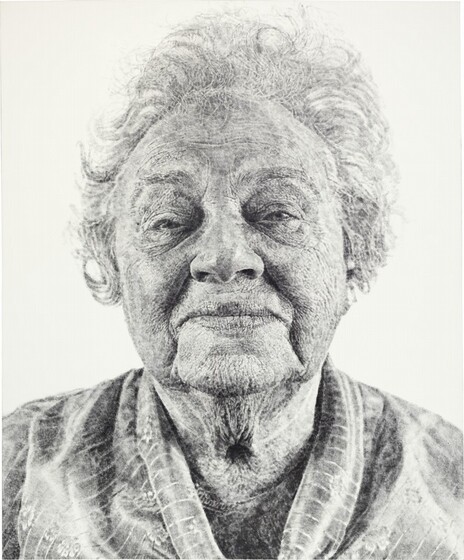
Chuck Close, Fanny/Fingerpainting, 1985, oil on canvas, Souvenir of Lila Acheson Wallace, 1987.2.1
Materials
- Smart Board or reckoner with power to projection images from slideshow
- Heavy cardstock (iv minor sheets per students) or other surface sturdy enough to build up texture
- Multiple sizes of brushes
- Variety of media: paints (tempera, watercolor, etc.), colored pencils, oil pastels, crayons
- Establish objects similar leaves, sand, stones, twigs, etc.
Warm-up Questions
Practise you recognize these marks? How do you lot call up the artist applied paint to the canvass?
Background
Texture is the look and feel of a surface. Painters accept many ways to create unlike textures. They use dissimilar sized and shaped brushes: everything from tiny pointed brushes to flat, wide brushes. They can also use other tools—special knives, sponges, even fingers—to put paint on sheet.
What are some ways that artists create texture?
- They brush pigment on in watery strokes and thick drips.
- They put paint downwards in short, fat dabs and long, sleek strokes.
- They twirl their brushes to brand circles and curls.
- They apply paint in thick layers that stick out from the canvas.
- They put different colors on top of each other.
- They mix in sand, dirt, or other materials into the paint.
- They add white highlights to make things look shiny.
- They scratch through paint to show colors underneath.
Chuck Close worked from a black-and-white photograph of his wife'southward grandmother, Fanny to create Fanny/Fingerpainting. He divided his canvas into a grid, and so, square past square, pressed the marks of his fingers to the canvas to make this portrait of Fanny. Carefully layering his fingerprints onto the canvas, he built up the lines of her confront and neck. Close explained, "I like using the body as a tool for painting . . . by using my hand, I can experience only how much ink is on my finger and so I can experience very clearly how much I'1000 depositing on the painting."

Leonardo da Vinci
Italian, 1452–1519
Ginevra de' Benci [obverse], c. 1474/1478
oil on panel, 38.1 x 37 cm (15 10 14 9/16 in.) (thickness of original console): 1.i cm (7/16 in.)
National Gallery of Art, Ailsa Mellon Bruce Fund
Five hundred years earlier artist Chuck Close pressed his fingers to sail to brand Fanny/Fingerpainting, Leonardo da Vinci also used his fingers to polish oil pigment for the perfect skin of his teenage model, Ginevra de' Benci. Da Vinci first used small brushes to paint Ginevra'due south face. He applied the pigment in very sparse layers. But in the end, he needed his fingers to get the articulate await and smoothen shadows that form her face up. How practise we know? Fine art specialists looked at Ginevra'due south face up with loftier tech equipment to discover the traces of da Vinci'southward fingerprints (pictured beneath). Scholars believe he used his fingers to polish and soften the edges and surfaces of her face while the pigment was still wet.

Particular of da Vinci's Ginevra de' Benci showing his fingerprint
Leonardo wrote, "Encounter that your shadows and lights blend like smoke without strokes or borders." This technique, which came to be called sfumato (literally "smoky"), represented a radical break with traditional painting techniques, which relied on line to define forms. In avoiding line, Leonardo was able to attain a more lifelike painting.
Guided Practice
Collect examples of the following various textures for students to examine and feel. So view the slideshow below and accept students observe those textures in the works of art:
|
|
|
Slideshow: Textures in Paintings
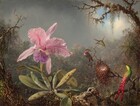

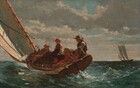

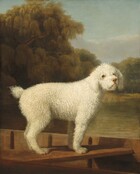
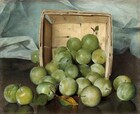

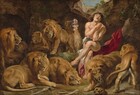
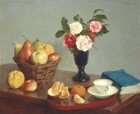
How exercise you think these textures were achieved? You may want to refer to the list in the "Background" section.
Activity
Each student should select 1 object examined in course and represented in a painting in the above slideshow. Accept them draw the basic shape of the object on four separate sheets of newspaper. Next, accept them fill in each line drawing using unlike media and tools to create various textures. If accessible, take students on an outdoor walk to collect various objects (leaves, twigs, etc.) to attempt out in the classroom. Students should experiment by using multiple sizes of brushes, mixing in anarchistic materials like sand, creating different patterns, adding more media or scrapping information technology away, or other artistic avenues they arrive at using the materials responsibly and safely.
As an alternative to suit motor command differences, the instructor can cut stencils of a educatee's called object from heavy paper, and then tape the stencils to the other iv pieces of paper for the educatee to paint over.
Extension
Students volition then select 2 of their works of art and use a Venn diagram to compare and contrast the process they used to create each piece and what the stop product looks like. They should share their findings with fellow pupil artists.
The Elements of Art is supported by the Robert Lehman Foundation
National Core Arts Standards
VA:Cr1.1.4Brainstorm multiple approaches to a creative art or design problem.
VA:Cr1.ii.3 Apply knowledge of available resources, tools, and technologies to investigate personal ideas through the art-making process.
VA:Cr2.1.iii Create personally satisfying artwork using a variety of artistic processes and materials.
VA:Cr2.2.3 Demonstrate an agreement of the safety and skilful apply of materials, tools, and equipment for a variety of artistic processes.
VA:Re7.one.three Speculate about processes an artist uses to create a work of art.
VA:Re7.2.4 Analyze components in visual imagery that convey messages.
VA:Re8.i.3 Interpret art past analyzing employ of media to create field of study matter, characteristics of form, and mood.
Source: https://www.nga.gov/learn/teachers/lessons-activities/elements-of-art/texture.html

Postar um comentário for "Different Types of Things to Talk About in a Art Paper"